Suicide bereavement
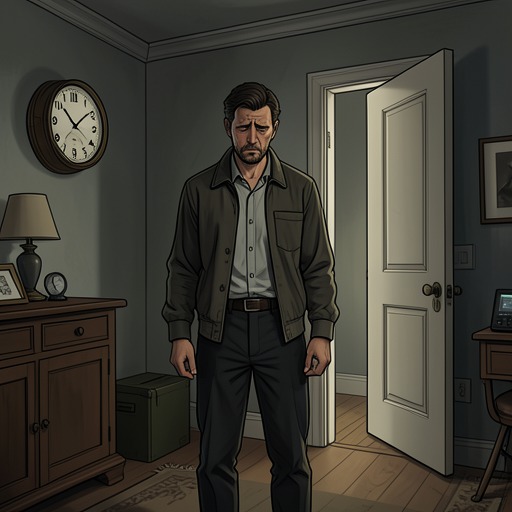
The FriendSuicide bereavement in the book is not a puzzle that can be solved or a passage completed by forgetting. It is a continuing relationship with Deceased Friend, marked by the Narrator’s reluctance to speak, her awareness of how others judge suicide, and a gradual change that offers the possibility of release without erasing love or loss.
A death that did not fit expectation
The Narrator recalls that Deceased Friend had talked about suicide, but that very fact helped obscure the possibility that he would act. She and others mistook repeated discussion for evidence that the act itself would not happen. In her recollection, Deceased Friend was not the unhappiest person they knew, nor the most depressed, nor even the most suicidal. The mismatch between what those around him thought they knew and what happened leaves bereavement entangled with retrospective doubt: visible distress and familiar talk had not made the outcome legible.
The timing, close to the beginning of the year, made the death seem as though it might have been a resolution. Elsewhere, Deceased Friend had predicted a coming wave of suicides among writers and answered that it would happen soon. The prediction acquires a disturbing afterlife in light of his death, but it does not supply an explanation for it. The Narrator’s account holds those facts together without turning foreknowledge, professional identity, or a pattern among writers into a complete account of one person’s choice.
That limit matters in the Narrator’s recollection of a radio program about suicide loss. Callers used moralizing labels, describing people who died by suicide as selfish, spiteful, cowardly, irresponsible, or ungrateful, and treated suicide as a wrong for which the person who died must be blamed. The Narrator finds none of this helpful. Books she read offered historical and philosophical arguments, including accounts in which voluntary death could be regarded as permissible under certain conditions, but information did not dissolve the personal mystery. Public judgment and explanation alike fail to make the loss shareable or settled.
The need for silence and the difficulty of company
The therapist gently identifies one consequence of the loss: the Narrator no longer wants to be with other people. Her own account is more intense. She does not merely dislike company; she is frightened of it, and even without concern about leaving Apollo, she would prefer to be alone. The bereavement therefore alters ordinary social life, not just the occasions on which Deceased Friend is discussed.
The Narrator is explicit about the boundary. She does not want to talk about Deceased Friend or hear other people talk about him, even when she is required to explain why she does not want to talk. This refusal is not presented as a lack of feeling. It sits beside her acute sense of absence and her repeated insistence that she misses him every day, very much. Silence becomes a way of protecting what cannot be made adequate by conversation, rather than evidence that the bond has disappeared.
A story told by a woman who had been widowed by her young husband offers the Narrator a different response to the demand for explanation. At first, the woman felt she owed him every effort to understand his death. She later decided that he had chosen silence and that his mystery should be left to him. The Narrator finds this account helpful where condemnations and books had not been. It makes room for an ethical limit: the bereaved may seek meaning, but need not claim to recover the motives of the person who died.
The bond carried into daily life
The Narrator’s grief persists through direct address to Deceased Friend. She imagines that the dead inhabit conditional statements, a grammar of unrealized possibilities, while also feeling that Deceased Friend has become omniscient and can read what she writes before she writes it. The contradiction gives the address its force: the dead person is absent from ordinary life, yet remains an imagined reader and presence within the Narrator’s thoughts.
Her care for Apollo gathers this continuing bond into a concrete and uneasy form. The Narrator wonders whether loving and sacrificing for Apollo might somehow bring Deceased Friend back. She recognizes the thought as irrational, but its emotional logic is clear: Apollo is beautiful, aging, and melancholy, and his survival has become bound up with the wish to save something associated with the person who is gone. On the anniversary of Deceased Friend’s death, she watches a video of him reading. Apollo does not seem to focus on images on a screen, but the Narrator wonders whether he might recognize the voice. She cannot bring herself to test this, fearing that Apollo might think Deceased Friend is trapped inside the device. Concern for Apollo thus becomes both an expression of care for the living animal and a way of reckoning with the relationship he had with the dead.
The Narrator also admits that the boundary between speaking to Deceased Friend and speaking to herself has blurred. This uncertainty does not resolve into a claim that he has returned; instead, the writing makes visible how bereavement keeps the absent person within the survivor’s inner address. The repeated declaration that she misses him, appearing again near the end, gives this bond a plain verbal form that explanation cannot replace.
Writing, memory, and an unfinished change
Writing about the loss carries its own risk. The Narrator considers how an account meant to preserve an experience or understand its meaning might eventually displace the memory itself, so that the remembered event becomes chiefly a memory of having written about it. Speaking too much about someone lost might, in her fear, bury that person rather than keep him present. Writing is therefore neither a guaranteed cure nor a neutral record; it can sustain remembrance while also changing what is remembered.
The Narrator does not describe her later state as healing, recovery, or closure. She recognizes something different, a preparation or approach toward release, while emphasizing that she has not arrived there. Her imagined account of Deceased Friend’s thinking is similarly tentative: perhaps he convinced himself that those left behind would endure shock, grieve, and eventually carry on. She can accept that possibility if it helped him escape further suffering, but the thought remains an idea, not knowledge of his final motives.
The book’s ending preserves this incompletion. The Narrator wants to call Deceased Friend’s name, but the word dies in her throat; immediately afterward comes an anguished apostrophe to her friend. The movement from blocked speech to direct address does not amount to a tidy farewell. It gathers the central tensions of suicide bereavement—the desire to speak, the need to respect silence, and a grief that changes without simply vanishing—into a final moment of connection.